
Thermal Spraying … mechanically bonded high-performance surfaces
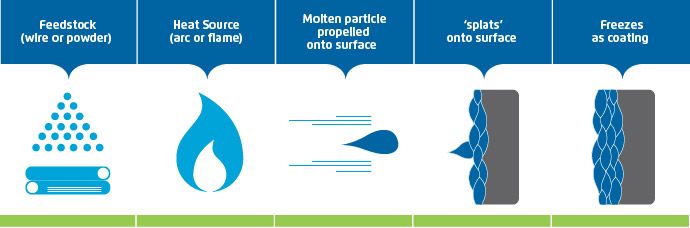
Thermal Spraying is a coating process which produces high-performance surfaces with absolutely no risk of distortion or metallurgical changes to the component. Laserbond has a range of coating processes to apply cost-effective metallic or non-metallic based coatings onto (usually) metallic substrates.
In these processes, the coating material is introduced to an extreme heat source in the form of wire or powder. The molten material is transferred to the component at a very high velocity where it mechanically bonds to the substrate. Our thermal spray booths are designed for both high volume production and short-run projects.
At Laserbond we use a number of thermal spray processes including
- High-Velocity Oxy-Fuel (HVOF) and High-Velocity Air-Fuel (HVAF)
- Plasma Spraying (APS)
- Wire Arc Spraying
- Flame Spraying
- Spray and Fuse
Benefits:
- No dilution or distortion of components
- Can be applied on many base materials, including cast iron and composites (CFC and GFC)
- Wide range of coatings available, including ceramics and cements
- Highest wear protection
- Corrosion protection
- Electrical insulation
- Thermal insulation
- Cost-effective life extension
Applications:
- Knife edges, blades and cutting tools
- Wear surfaces
- Part-to-part sliding abrasion sites
- Thermal Barrier Coatings (TBC) for turbomachinery
- Shafts, journals and sleeves
Frequently Asked Questions
What is thermal spraying?
Thermal spraying is in layman’s terms spray painting with molten metal. Thermal spraying is a process in which surfacing materials are heated to the plastic or molten state and then propelled on to a prepared surface; the substrate remains unmelted.
What thermal spray processes does Laserbond offer?
Laserbond does offer all thermal spray processes according to ISO 14917, with the exception of cold gas spraying. These are
- Flame Spraying (wire/powder)
- Arc Spraying
- Atmospheric Plasma Spraying – APS
- High Velocity Oxy/Air Fuel Spraying – HVOF/HVAF
- (Laser Spraying (cladding)
- (PTA welding)
LaserBond was founded as HVOF Australia in 1992, offering liquid fuel HVOF as a first to the Australian market.
What is HVOF and when is it used?
HVOF is a Thermal Spray process. High Velocity Oxygen Fuel (HVOF) Spraying uses a pressurized combustion chamber followed by a Laval type nozzle. The hot gas stream expands through the nozzle into which the powder is injected, accelerating the powder particles to supersonic velocities up to 1,000 m/s. This high kinetic energy results in very dense (<1 % porosity), well adhering coatings (>80 MPa) with low oxide content. Tungsten carbide for extreme wear resistance is the most used coating material for HVOF.
What is the difference between thermal spray and laser cladding?
The difference between laser cladding and thermal spraying is, in thermal spraying the substrate material is not melted, so the microstructure is not affected. The minimum and maximum coating thickness achievable: Thermal spray: 0.05-1mm, laser cladding: 0.2-infenite. Materials: laser cladding limited to metals and metal matrix composites (MMC), TS: metals, MMC, ceramics
What industries use thermal spray coating?
Thermal spray coatings are used in many industries. Typical applications include bioactive coatings for medical implants, thermal barrier coatings for turbine blades, corrosion resistant zinc coatings for wind turbines, coating and repair of pump components, boiler tubes in energy plants, hard chrome replacement for hydraulic rods and steel mill rollers.
Can thermal spray replace hard chrome plating?
Yes Thermal Spraying, especially HVOF, was the first coating process qualified as a hard chrome replacement for landing gears. This resulted in the aerospace standard AMS2447, issued in 1998. Since then, thermal spraying has been specified as a hard chrome alternative in many industries including mining, aerospace, fluid handling and heavy industries.
 FR
FR  EN
EN  JA
JA  AR
AR  HI
HI  BN
BN  ES
ES  ZH
ZH  PT
PT  IT
IT  DE
DE