
What is Laser Cladding?
By Dr. Christiane Schulz, Technical Product Manager
Introduction
Component wear is one of the quiet costs industrial operations has come to accept as inevitable. A worn pump shaft, a pitted valve seat, or an eroded drive spindle rarely fails without warning but the cumulative cost of unplanned downtime, emergency replacements, and lost production can run into the millions of dollars annually, or even daily, for a single plant. Across mining, power generation, and fluid handling, the same story repeats: capital equipment is engineered to last decades, yet the surfaces exposed to friction, corrosion, and impact often fail years ahead of the rest of the component. Replacing an entire part because its surface has degraded is expensive, wasteful, and often avoidable.
This is the problem laser cladding was developed to solve. Rather than replacing a worn component outright, laser cladding restores and enhances its working surface extending service life, often beyond the original specification, while leaving the rest of the part untouched. It has become one of the most important tools in modern surface engineering and understanding how it works is the first step to understanding why it matters.
What is Laser Cladding?
Laser cladding is an advanced surface engineering process that uses a high-powered laser to apply a layer of cladding material onto the surface of a component. Laser Cladding is the modern advancement of deposition welding technology. Like all welding processes, e.g. arc welding and plasma transferred arc welding PTAW, the overlay material is metallurgical bonded to the parent material. Unlike coatings that simply sit on top of a surface, a laser clad layer becomes chemically and physically integrated with the substrate, giving it exceptional strength, wear resistance, and durability.
The process is also known by several other names depending on the industry and standard being referenced, e.g. Laser Metal Deposition (LMD) or Direct Energy Deposition (DED-L). Regardless of terminology, the underlying principle is the same: a precisely controlled laser beam melts the substrate surface creating a melt pool. Cladding material in the form of powder or wire is injected into the melt pool, allowing the two to fuse together.
Because the process is so tightly controlled, laser cladding can be applied to build up worn dimensions, apply a protective surface to a brand-new part, or completely restore a component that would otherwise be scrapped. It is used both to extend the life of new equipment and to remanufacture components that have already seen years of service.
How Does Laser Cladding Work?
The laser cladding process in cross-section
-
The laser cladding process uses a high-power laser typically operating in the range of several kilowatts directed onto the surface of the component. A melt pool is created which is protected by an inert shielding gas, typically Argon, to avoid unwanted reactions with air. The melted substrate and the feedstock material fuse together and solidify rapidly. As the laser moves relative to the parts surface a bead is applied. By overlapping multiple beads, the parts surface is covered with one layer of a coating. On top of 1 layer, another one or several ones can be applied, to increase cladding thickness or create an Additively Manufactured feature.
-
The laser applies heat in a highly localised, precisely regulated way. Therefore, dilution between the coating and the substrate is kept extremely low typically below 5%, which preserves the purity and performance of the cladding material. This precision also means microstructural changes of the parent material are minimal. The heat-affected zone HAZ is very small (~1mm), and substrates deemed unweldable, such as cast irons can be laser clad.
-
The result is a true metallurgical bond, usually with a higher strength than the component. This means the clad layer will not delaminate, chip away, or separate from the substrate under load. Multiple layers can also be built up where needed, allowing components to be restored to their original dimensions or engineered with entirely new surface properties.
Laser Cladding vs Traditional Methods
Industrial operators have historically relied on arc welding, thermal spraying and hard chrome plating to protect or restore component surfaces. Each has its place, but laser cladding offers distinct advantages in coating density, environmental impact and long-term reliability.
Hard chrome plating in particular is under increasing regulatory pressure due to the environmental and health hazards of hexavalent chromium, and laser cladding alternatives have been shown to significantly outperform it in both wear and corrosion resistance while using a fraction of the energy.
| Feature | Revestimento a laser | Pulverização Térmica | Hard Chrome Plating | Arc welding |
|---|---|---|---|---|
| Bonding mechanism | metallurgical bond | Mechanical interlocking | Diffusion | Metallurgical bond |
| Coating density | dense, very low porosity | some porosity | Dense but prone to micro-cracking | dense, very low porosity |
| Heat input to substrate | low, minimal HAZ | Very Low | None (cold process) | high |
| Coating thickness | 0.2 mm – indefinite | 0.1-1 mm | 0.02-0.4mm | 2mm-indefinite |
| Environmental impact | Low, generally clean process | Low, generally clean process | Uses hexavalent chromium, environmentally hazardous | Low, generally clean process |
| Typical use case | High-value, critical wear components | Broad-area, moderate-duty coatings | Cylindrical rod and bore surfaces | General repair |
Coating thickness by method, from the table above (logarithmic scale)
What Materials Can Be Laser Clad?
One of laser cladding’s greatest strengths is its material flexibility. Stainless steels, including super duplex grades, can be applied to improve corrosion resistance in harsh environments. Nickel and cobalt-based alloys are widely used where high temperature strength or chemical resistance is required, such as in chemical industry and boiler applications. Tungsten carbide composites provide exceptional wear resistance for components exposed to highly abrasive conditions.
Perhaps most significantly, laser cladding can successfully apply materials that are difficult or impossible to weld using conventional methods, due to their tendency to crack or embrittle under high heat input. The precision and low dilution of the laser process make it possible to apply these “unweldable” alloys reliably, opening up surface engineering solutions for components that previously had none.
Industries That Use Laser Cladding
Mineração relies on laser cladding to restore and protect components subjected to constant abrasive wear, such as drive spindles on heavy processing equipment, where cladding can extend service life well beyond that of the original part.
Geração de energia uses laser cladding to protect high-pressure valves and boiler components from erosion and high-temperature corrosion, helping plants maintain reliability and avoid costly unplanned outages.
Fluid handling applications, including marine and industrial pumps, use laser cladding to rebuild and protect impellers, casings and shafts damaged by cavitation, erosion and corrosion, restoring performance without the cost of full replacement.
Why Choose Laserbond?
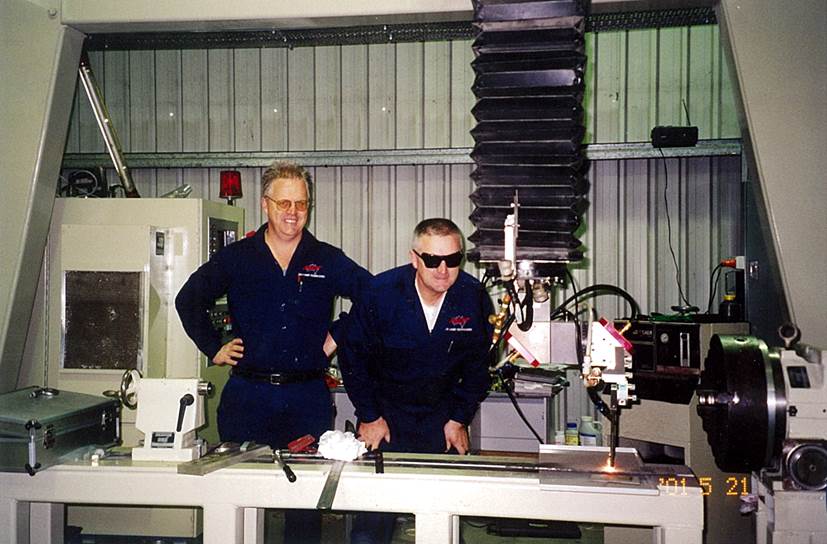
Laserbond was the first company to commercialise laser cladding as a surface engineering process in the Southern Hemisphere, and one of the first in the world, having commissioned its original high-powered laser cladding system in 2001. That early investment in multi-axis robotics and proprietary metallurgy set the foundation for a business that has spent over two decades refining the process for the most demanding industrial applications.
Today, Laserbond’s capability spans components weighing a few grams up to 25 tonnes, with diameters up to 2000mm and lengths up to 6 metres, a scale few competitors can match. Independent testing has confirmed the performance advantage of Laserbond’s proprietary cladding products, with results showing dramatically higher wear and corrosion resistance compared with conventional hard chrome coatings. This combination of pioneering experience, in-house engineering, and proven field performance is why industry leaders across mining, power generation, and fluid handling continue to trust Laserbond with their most critical components.
Conclusion
Laser cladding has moved from a niche surface engineering technique to an essential tool for industries where component wear carries real financial consequences. By creating a true metallurgical bond with minimal heat input, it delivers a level of durability and precision that traditional methods struggle to match — restoring worn components, protecting new ones, and keeping critical operations running longer, more reliably, and more cost-effectively.
About the Author
Dr Christiane Schulz – is a surface engineer with a technical
specialisation in materials and coatings for wear and corrosion protection,
and is an international expert in Laser Cladding, Additive Manufacturing and
Thermal Spraying with a PhD from RWTH Aachen University, Germany. Dr Schulz
is a former president of the Australasian Corrosion Association (ACA), a
certified Materials Professional (CMatP) by Materials Australia and a committee
member for Standards Australia in the working groups ‘corrosion of metals’ and
‘Pressure Equipment’.
Frequently Asked Questions
What is laser cladding?
Laser cladding is a coating process where a laser melts metal powder or wire onto a substrate, forming a fused, metallurgically bonded overlay. It is used to remanufacture worn parts, apply wear and corrosion-resistant coatings, or add features to components layer by layer. Another term commonly used is Laser Metal Deposition LMD.
How does laser cladding work?
A focused laser creates a melt pool on the part’s surface. Powder is injected into this pool, shielded by gas to prevent oxidation, forming a metallurgical bond with the substrate. Unlike arc or PTA welding, dilution (substrate mixed into the clad) stays below 5%. Moving the laser across the part produces a dense, pore-free coating.
What is the difference between laser cladding and thermal spraying?
The difference between laser cladding and thermal spraying is the bonding mechanism of the cladding. Laser cladding creates a strong metallurgical bond whereas thermal spray coatings adhere by mechanical interlocking to a grit blasted surface with bond strength up to >80 MPa.
What industries use laser cladding?
Laser Cladding is used in many industries today. Examples include hard chrome replacement for struts on mining trucks, claddings for boiler tubes to protect them from erosion and corrosion, remanufacturing of pump components in aggressive environments, wear resistant overlays for agricultural knives and tools.
Is laser cladding better than hard chrome plating?
Yes. The advantages of laser cladding over hard chrome plating are: No toxic hexavalent chromium is used; No maximum coating thickness; Variety of coating materials to suit the application environment; Dense, crack free coating to avoid undercorrosion that leads to catastrophic failure.
What is the maximum thickness Laserbond can laser clad?
The maximum thickness Laserbond can laser clad is limited by economical considerations, not technical ones. There is no maximum coating thickness that can be laser clad. Laserbond applies routinely 10 mm and more thick layers on components for remanufacturing and very thick wear resistant claddings.
What materials can be applied using laser cladding?
All materials that are metallurgical compatible to the base material. For steel substrates commonly used are stainless steels, Nickel-superalloys, Cobalt-based materials, Nickel/WC hardfacings, bronzes. Laser cladding, in contrast to traditional welding processes, applies little heat to the substrate material, so that even materials that are deemed unweldable, such as cast irons, can be clad.
What is the history of laser cladding?
The history of laser cladding dates back to the 1970s when it was invented. It remained a research topic until the 2000s. Laserbond first used laser cladding commercially in 2001 and was back then one of the first global adopters of the technology. In 2014 Laserbond patented a deposition method of tungsten carbides.
How long does a laser cladding coating last?
A laser cladding lasts up to 50x longer over an unclad part. This is achieved through selection and correct application of materials that are metallurgically advanced. Especially in harsh environments with overlapping abrasion and corrosion laser cladding offers a step change in service life improvement.
 PT
PT  EN
EN  JA
JA  AR
AR  HI
HI  BN
BN  ES
ES  ZH
ZH  IT
IT  FR
FR  DE
DE